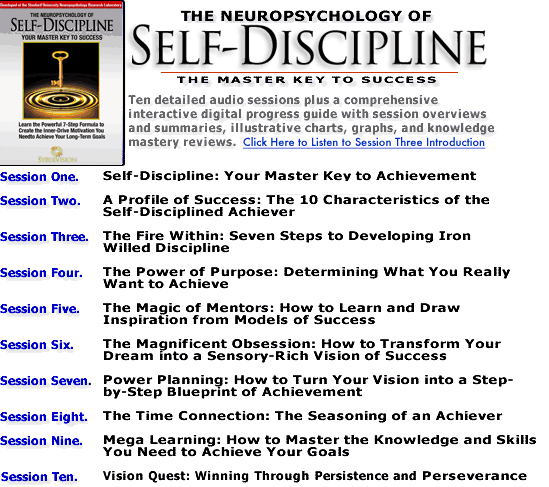
 | The Neuropsychology of Self-Discipline consists of 10 comprehensive audio sessions (chapters) and a 100 page digital study and personal success guide. Download Now! |
| | Today we live in a culture where many people want instant success—wealth, a beautiful body, warm relationships, and knowledge, This "I want it now" mentality is called "instant gratification" and is the number one reason people fail. (See the Stanford Marshmallow Study)
Life's Real Winners
People who reject the value of instant gratification and develop the skill of self-discipline are life's real winners. These are people who have developed "emotional intelligence—they are able to set goals and harness the motivational strength to see it through to their successful fruition— day by day, week by week, month by month, and, if necessary, year by year. They know any worthwhile achievement takes time and sustained effort. They are willing to pay the price. They are self-starters, doers, and finishers.
The good news is that self-discipline is a skill that can be learned. The Neuropsychology of Self-Disciple is where you learn it.
The Secret Revealed.
The Neuropsychology of Self-Discipline is a self-paced audio program that consists of 10 audio sessions and a digital study guide. It is based on research conducted by author Steve DeVore and Dr. Karl Pribram at the Stanford University Neuropsychological Research Laboratories. He studied over 100 of history's greatest achievers (see The World's 100 Greatest People Audio Collection) and identified the characteristics they had in common, From these characteristics he distilled a powerful formula for self-motivation— the secret of lasting success.
| KEY TO MASTERING SELF-DISCIPLE DISCOVERED | All lasting success in life is based on our ability to set challlenging goals and then to work toward them, no matter how difficult it is or how long it may take, until they are achieved. This ability to motivate ourselves, to persevere and persist until our goals are achieved is "self-discipline."
Through research at Stanford University and through an in-depth study of history's greatest achievers (see "The World's 100 Greatest People Audio Collection" authored by SyberVision founder and Self-Discipline author Steve DeVore), SyberVision discovered that self-discipline is a deeply rooted, core passion (emotion) that sustains our actions (motion) over a long period of time. And, self-discipline is a skill tht can be learned through a six-step process.
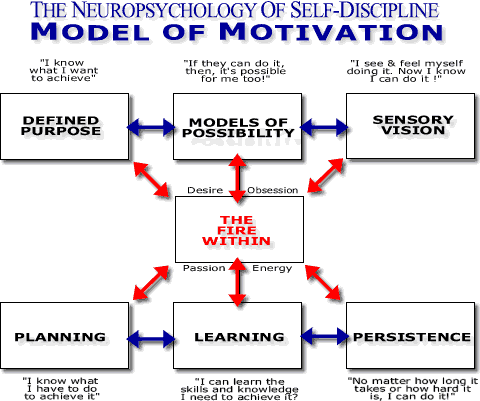
To build this passion, thie "fire within" you must first know what you want to achieve. "The Neuropsychology of Self-Discipline" shows you how to identify the things that are most important to you and to tranform these "desires" into emotion provoking goals and actions necessary to achieve those goals. Below is the seven-step process you will go through as you follow and master the principles detailed in "The Neuropsychology of Self-Discipline."
| |

|  |


Steve DeVore (l) wife Kathy and two grandchildren.
| Steve DeVore
Mr. DeVore is the founder of SyberVision and the developer of the acclaimed SyberVision learning system based on research he conducted at the Stanford University Neurological Research Laboratories. Mr. DeVore collaborated with Dr. Karl Pribram the founder of the modern day science of neuropsychology in the development of his learning systems. DeVore conducted extensive field research in personal achievement and self-motivational systems at Stanford working the with Stanford Department of Education and the Department of Athletics. He is renown for his work in visual modeling—how we learn and assimilate (neurologically, psychologically, and | cognitively) skills and behaviors from the observation of others. He has designed training systems for both collegiate and professional football, basketball, and baseball teams, U.S. Olympic teams and the U.S. Air Force's Strategic Air Command. Training Center (simulator training for B1 flight crews flying at 500 mph at 100 foot altitudes in combat situations).
DeVore also developed the highly acclaimed "The World's 100 Greatest People," "The World's 50 Greatest Composers" and "The World's 100 Greatest Books" audio collections. These collections were accepted and marketed by Encyclopedia Britannica as part of their highly acclaimed knowledge library. |  | It was the research from these collections combined with his study in the neurological and psychological sciences that led to the development of The Neuropsychology of Self-Discipline and The Neuropsychology of Achievement. His published works have generated nearly $500 million in worldwide sales. |
 | Stanford University psychology researcher Michael Mischel demonstrated how important self-discipline (the ability to delay immediate gratification in exchange for long term goal achievement) is to lifelong success? In a longitudinal study which began in the 1960s, he offered hungry 4-year-olds a marshmallow, but told them that if they could wait for the experimenter to return after running an errand, they could have two marshmallows.
Those who could wait the fifteen or twenty minutes for the experimenter to return would be demonstrating the ability to delay gratification and control impulse. | About one-third of of the children grabbed the single marshmallow right away while some waited a little longer, and about one-third were able to wait 15 or 20 minutes for the researcher to return.
Years later when the children graduated from high school, the differences between the two groups were dramatic: the resisters were more positive, self-motivating, persistent in the face of difficulties, and able to delay gratification in pursuit of their goals. They had the habits of successful people which resulted in more successful marriages, higher incomes, greater career satisfaction, better health, and more fulfilling lives than most of the population. | | | Those having grabbed the marshmallow were more troubled, stubborn and indecisive, mistrustful, less self-confident, and still could not put off gratification. They had trouble subordinating immediate impulses to achieve long-range goals. When it was time to study for the big test, they tended to get distracted into doing activities that brought instant gratification This impulse followed them throughout their lives and resulted in unsuccessful marriages, low job satisfaction and income, bad health, and frustrating lives. |

|
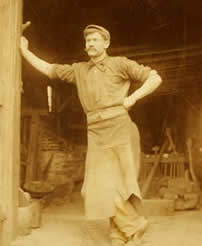 | The blacksmith follows the seven-step process of self-discipline to reach his goals. It's the only road to quality, lasting achievement.
The raw iron a blacksmith uses to create his works of art and necessity is much like the raw potential of an individual. It has to be molded into the desirable state. This process begins with a purpose—what do you want to accomplish—which in turn sparks a vision of the goal.
The experienced blacksmith knows he can reach his goals because he has spent years preparing himself to do so. As an apprentice, he learned by watching his master. Since the master was successful, he realized that doing the job was possible. And, he realized that he could do it too if he gained his master's skills. |
The Village Blacksmith
By Henry Wadswoth Longfellow
|  | With measured beat and slow,
Like a sexton ringing the village bell,
When the evening sun is low.
And children coming home from school
Look in at the open door;
They love to see the flaming forge,
And hear the bellows roar, Singing in the village choir,
And it makes his heart rejoice.
It sounds to him like her mother's voice,
Singing in Paradise! |
Under a spreading chestnut-tree
The village smithy stands;
The smith, a mighty man is he,
With large and sinewy hands;
And the muscles of his brawny arms
Are strong as iron bands.
His hair is crisp, and black, and long,
His face is like the tan;
His brow is wet with honest sweat,
He earns whate'er he can,
And looks the whole world in the face,
For he owes not any man.
Week in, week out, from morn till night,
You can hear his bellows blow;
You can hear him swing his heavy sledge,
| He needs must think of her once more,
How in the grave she lies;
And with his hard, rough hand he wipes
A tear out of his eyes.
Toiling-rejoicing-sorrowing,
Onward through life he goes;
Each morning sees some task begun,
Each evening sees it close;
Something attempted, something done,
Has earned a night's repose.
Thanks, thanks to thee, my worthy friend,
For the lesson thou hast taught!
Thus at the flaming forge of life
Our fortunes must be wrought;
Thus on its sounding anvil shaped
Each burning deed and thought! | | |